
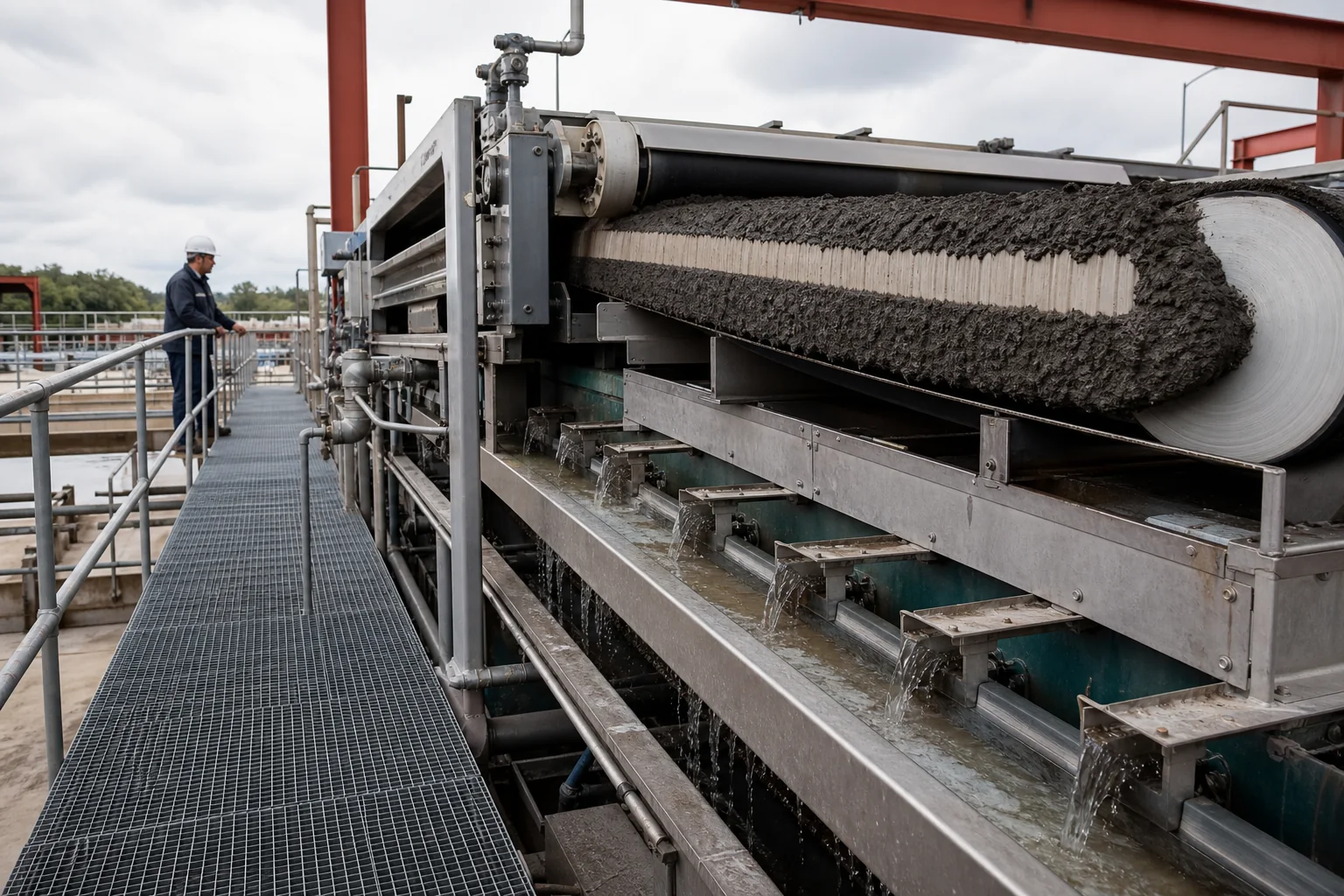
The first minutes of belt press observation reveal whether cationic PAM is releasing free water and creating a feed that the press can transport. The final decision must balance drainage, capture, cake, belt condition and cost.
Stabilize the sludge and press
Record feed flow and solids, belt speed, belt tension, wash pressure, sludge spread and current polymer dose. Correct blocked spray bars, tracking problems and gross mechanical issues before comparing grades. Use the same feed period where possible.
Inspect gravity drainage
Observe how quickly free water separates, whether sludge remains uniformly distributed and whether solids migrate through or over the belt. Collect filtrate at consistent locations. A very large floc may drain poorly if it seals the belt surface.
Track the wedge and pressure zones
Watch for lateral squeeze-out, uneven loading and floc breakdown. The conditioned sludge should enter pressure gradually and remain coherent. Record cake thickness and release at discharge instead of judging only by appearance upstream.
Recognize underdose and overdose
Underdose may show weak floc, slow drainage and solids loss. Overdose may create sticky sludge, blinded fabric, difficult cake release or hazy filtrate. The exact symptoms depend on feed and grade, so include a deliberate high point in the controlled test.
Confirm solution quality
Inspect make-down concentration, maturation, undissolved particles and secondary dilution. Poorly hydrated dry polymer can accumulate on fabric. Excessively concentrated solution may distribute unevenly. Calibrate solution flow before calculating active dose.
Measure the combined endpoint
At each dose record cake solids, filtrate solids or turbidity, capture, throughput, belt speed, wash demand and cleaning observations. Calculate active polymer per dry ton and cake disposal impact. A stable middle setting can be more valuable than a narrow maximum.
Use a bench drainage screen correctly
A screen, funnel or drainage test can remove weak candidates before plant work. Match mixing and timing, but recognize that pressure and belt weave are absent. Confirm finalists on the actual press under normal variation.
Retain the approved operating envelope
Document product code, solution method, dose range and acceptable feed condition. Connect the result to the belt press product path and purchasing specification.
EPA background on belt filtration and conditioning can support the trial plan, but product choice remains feed-specific: Design Manual: Dewatering Municipal Wastewater Sludges.
Divide the belt into observation zones
Use the same named locations for every test: feed distribution, early gravity drainage, late gravity zone, wedge, first pressure section and discharge. Record filtrate and solids behavior at each point. This prevents a strong early impression from hiding later squeeze-out, blinding or poor release.
Measure drainage without overinterpreting it
A timed screen test can measure water volume and clarity, but faster is not always better. Very rapid drainage can accompany brittle floc that breaks later, while a slower but coherent feed may perform better under pressure. Use the bench test to remove obviously weak candidates and to choose plant starting doses, not to predict final cake exactly.
Check the belt and wash system
Inspect fabric condition, permeability, seam, spray nozzles, water pressure and alignment. Polymer deposits or undissolved particles can reduce permeability. Compare the cleaned baseline before blaming the new product. Record wash-water demand because a grade that requires frequent cleaning changes total operating cost and available throughput.
Control sludge distribution
Uneven feed thickness creates dry and wet bands and distorts cake samples. Confirm distributor condition and edge containment. Collect cake from representative positions or combine subsamples. A single dry edge sample can overstate the performance of the whole belt.
Set a balanced acceptance window
Define minimum capture and filtrate quality, desired cake solids, acceptable wash demand and required throughput. A product must meet all critical limits across a practical dose band. Retain the settings and images from stable operation so later shifts in belt or sludge condition can be compared against evidence rather than memory.
Build a shift handover check
Record feed solids, solution concentration, calibrated polymer flow, belt speed, wash pressure, filtrate appearance, cake sample and any cleaning action at handover. Photograph the gravity zone from the same safe position when conditions change. This helps the next shift distinguish a feed or mechanical change from a true product problem and preserves the validated dose window.
Recheck the approved condition after a significant belt replacement, sludge-blend change or preparation-system modification. Those changes can alter drainage and floc survival even when the product code is unchanged. Use the former record as a starting baseline, then confirm the operating window with measured steps.