
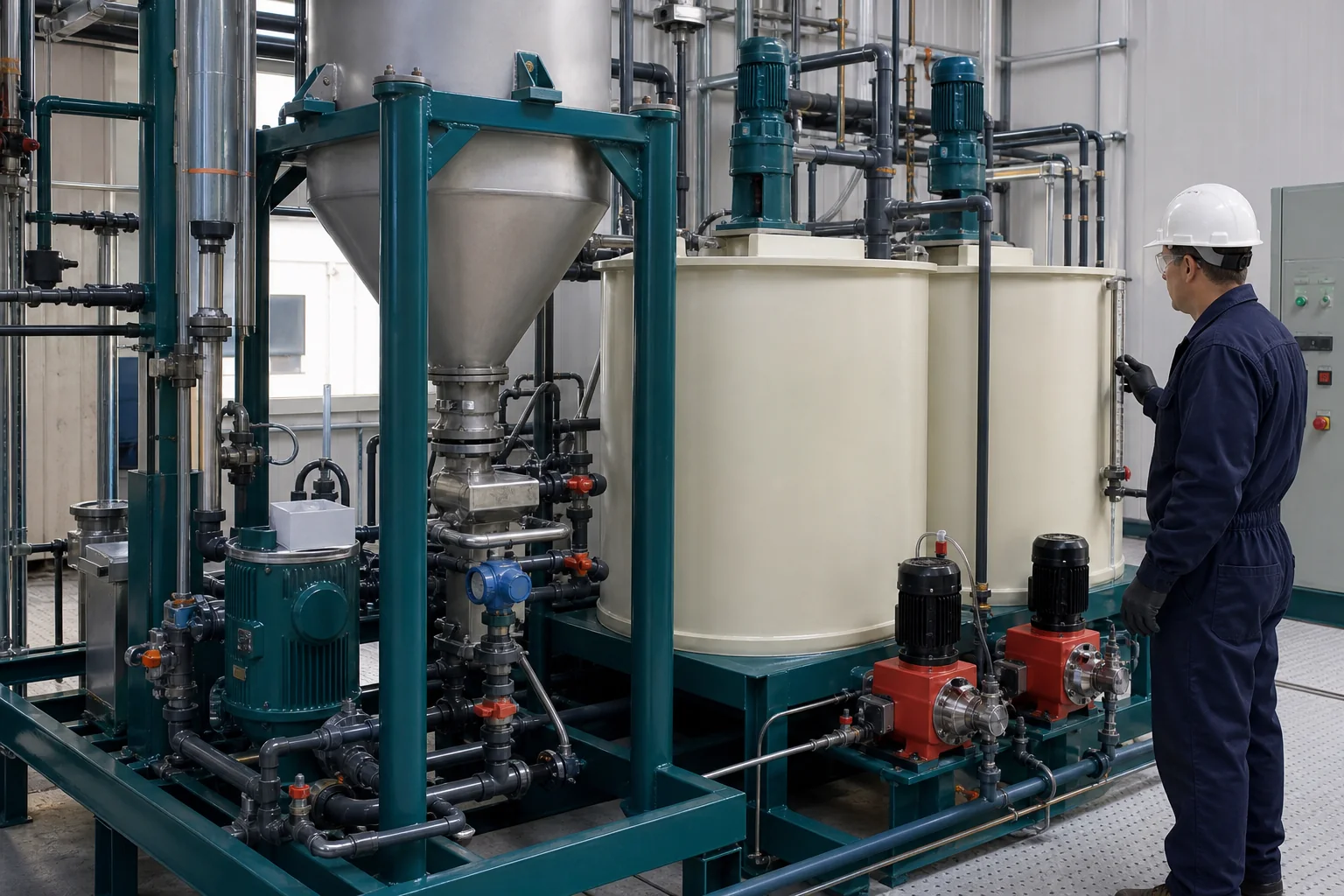
A suitable cationic PAM can appear weak when powder wetting, dissolution or distribution is poor. Preparation control should be verified before increasing dose or rejecting a grade.
Confirm dilution-water condition
Record water temperature, hardness, conductivity and pH where relevant. Use consistent water for comparative trials. Extremely cold water can slow hydration, while contamination and unsuitable high shear can affect solution quality.
Meter powder into moving water
Dry polymer should enter a well-distributed water stream at a controlled rate. Dumping powder into a tank promotes surface wetting, clumps and dry cores. Keep the feeder, induction device and surrounding area dry, and manage dust according to the SDS and plant procedure.
Use staged mixing
Initial dispersion requires enough motion to separate particles, followed by gentler agitation during hydration. Excessive local shear or recirculation through unsuitable pumps can reduce solution performance. Follow the grade-specific procedure supplied with the product.
Provide adequate maturation
Solution should remain in the aging system long enough to hydrate before transfer. Record tank volumes, actual flow and operating level to determine residence time. A nominal tank size does not guarantee maturation if short-circuiting or excessive demand occurs.
Inspect the prepared solution
Look for fisheyes, undissolved material, surface gel and abnormal viscosity. Use a defined screen or dissolution check for incoming comparison. Do not compare viscosity values without the same concentration, water, temperature, instrument and method.
Use secondary dilution for distribution
Further dilution near the injection point can improve contact with sludge. Confirm dilution flow, pressure and mixing. Avoid excessive distance, restrictive valves or high shear after floc formation.
Control solution age and hygiene
Prepare manageable volumes and follow the product guidance for use time. Clean tanks and lines to prevent deposits and microbial growth. Do not blend incompatible products in the same system without a validated cleaning and changeover procedure.
Calibrate the dosing pump
Measure output at operating conditions and build a curve across the useful range. Calculate active dose from actual stock concentration and flow. Connect the preparation record to the dry-ton dose calculation.
For general product and application support, use the official Xinqi Polymer company site and the grade-specific technical documentation supplied with the order.
Verify feeder accuracy
Collect and weigh powder delivery over a safe defined interval or use an approved calibration method. Check several feeder settings because the relationship may not be perfectly linear at the low end. Compare indicated water flow with an independent measurement where possible. Preparation concentration cannot be trusted if either feed is wrong.
Prevent fisheyes at the source
Fisheyes form when the particle exterior hydrates into a gel shell before water reaches the core. Good induction spreads individual particles before they contact one another. Inspect the wetting cone, spray pattern and feeder position. Raising mixer speed after clumps form usually does not repair the solution and can damage hydrated chains.
Calculate actual aging capacity
Divide effective tank volume by solution flow and account for operating level and transfer sequence. During peak demand, a nominal one-hour system can deliver much younger solution. Use alternating tanks or staged compartments as designed and avoid bypass paths. Record residence during trials so grade comparisons do not use different hydration conditions.
Choose transfer equipment carefully
Use pumps and valves appropriate for viscous polymer solution and avoid unnecessary high-shear recirculation. Inspect for suction starvation, cavitation and pulsation. Flush and maintain the system under the plant procedure. Changes in pump or valve condition can alter actual delivery without changing the setpoint.
Create a daily preparation log
Record product lot, powder rate, water flow, concentration, tank level, make time, use time, visible solution quality and pump calibration status. Add corrective actions for clumps, feeder alarms or interrupted water. This simple record connects dewatering changes to preparation evidence and supports supplier lot evaluation.
Audit the system after a product change
A different cationic PAM may require a revised feeder setting, water ratio or maturation time even when the equipment remains unchanged. Verify concentration and pump calibration after changeover, inspect for residues from the former product and update operator instructions. Evaluate dewatering only after the new solution reaches a stable preparation condition; otherwise the trial compares two preparation states as well as two grades.
Keep solution-preparation samples and photographs only where plant procedure permits. The most useful evidence remains the recorded concentration, residence time, feeder output, visual dissolution check and calibrated delivery linked to the dewatering result.