
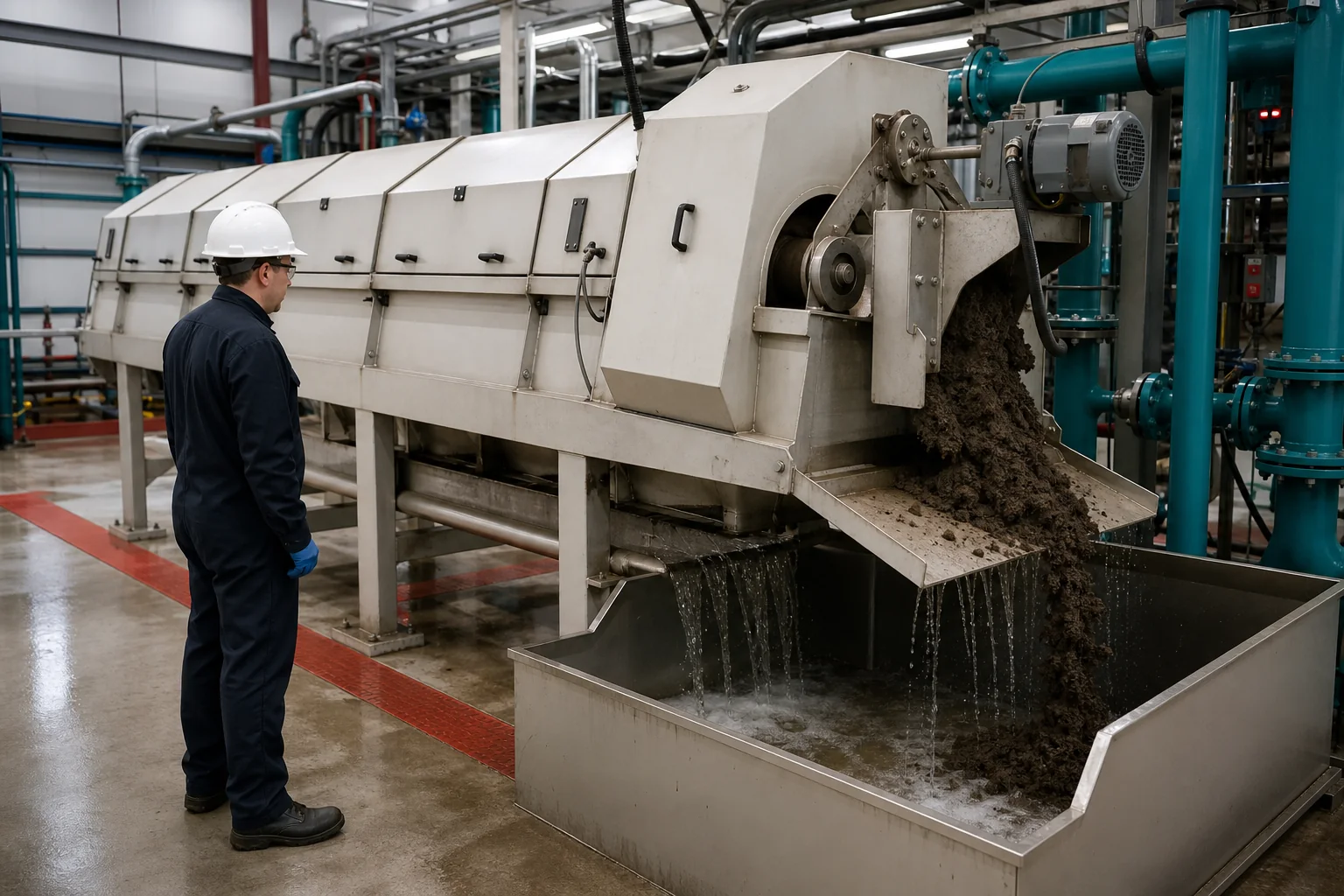
A screw press needs conditioned sludge that releases water early and continues moving through progressive compression. Polymer choice should support filtrate clarity and cake transport without creating sticky deposits or frequent cleaning.
Record the mechanical baseline
Document feed flow and solids, screw speed, back pressure, wash cycle, current polymer and machine condition. Check rings or screens, discharge and drive load. A mechanical restriction can resemble poor flocculation.
Observe the inlet and drainage zone
Floc should be present before significant compression. Watch free-water release and collect filtrate consistently. Fines in early filtrate can indicate underdose, weak distribution or wrong grade. Clear filtrate alone does not prove that cake transport will remain stable.
Follow the sludge through compression
Note pressure development, discharge consistency, cake stickiness and buildup. If increasing dose improves filtrate but causes coating or blockage, the operating point may have crossed into overdose. Reduce dose before adding another chemical.
Check preparation and injection
Confirm solution concentration, maturation, pump calibration and secondary dilution. Inspect injection location and contact time. Dry polymer particles or uneven high-viscosity solution can cause variable floc and deposits.
Compare charge and molecular range
Screen adjacent cationic charge levels at equal active dose. Then refine the molecular range within the useful family. A high-charge grade is not automatically the strongest choice; drainage, floc resilience and surface behavior must be observed on the feed.
Measure total operating performance
Record filtrate solids, cake solids, capture, throughput, drive load, cleaning frequency and active dose. Include cake handling and return-liquor impact in the cost. Select the grade that maintains acceptable performance across normal feed changes.
Diagnose persistent fines
If fines remain after dose and preparation are verified, inspect upstream coagulation, pH and feed blending. Test another charge range in a controlled matrix. If beaker response is good but machine response is weak, investigate injection, residence and mechanical condition.
Carry evidence into procurement
Retain the product code, lot, dose window and machine settings. Use the screw press product page to prepare the next sample request or production quotation.
General polymer-conditioning principles in the EPA dewatering manual provide useful context for press trials: EPA municipal sludge dewatering manual.
Use time-based observations
Screw presses respond more slowly than a beaker. After a dose or grade change, wait for treated sludge to pass through the drainage and pressure zones before sampling cake. Record the estimated residence and the time at which filtrate, drive load and discharge stabilize. Early samples can represent mixed conditions.
Distinguish chemical fouling from mechanical fouling
Sticky polymer-rich deposits may respond to dose reduction or a different grade, while mineral scale, fibers and worn components require other action. Inspect where buildup begins and what it contains. Review cleaning history and upstream industrial changes. Do not increase polymer to solve a physical blockage.
Track back pressure and cake together
Higher back pressure can raise cake solids but may also increase drive load, reduce throughput or squeeze fines into filtrate. Hold pressure constant for the initial product comparison. After selecting a stable polymer condition, optimize pressure and screw speed within equipment limits, recording the combined result.
Review intermittent feed operation
Plants that run the press intermittently must manage solution age, start-up feed and shutdown cleaning. Record how much off-spec filtrate occurs during transition and whether polymer delivery begins at the correct time. A grade that is stable at steady state can still create problems if the control sequence is poorly timed.
Use an operating envelope
Approve a range of feed solids, solution flow and machine settings rather than one ideal point. Define warning signs such as rising filtrate solids, coating, unstable discharge or load. Link each sign to a first check. This turns the polymer trial into a usable operating standard instead of a one-day demonstration.
Define the sample and RFQ package
Provide sludge origin, feed solids, press model or operating description, screw speed, back pressure, current active dose, filtrate and cake targets, monthly quantity and destination. Include photographs of the drainage zone and discharge only when taken safely. With that information, candidate grades can be selected for the actual compression and handling duty rather than from a generic screw-press label.
When results are reported to purchasing or technical support, include both the stable result and the failure boundary. Knowing where coating, fines or unstable discharge begins is essential for selecting a grade that operators can control during normal feed variation.