
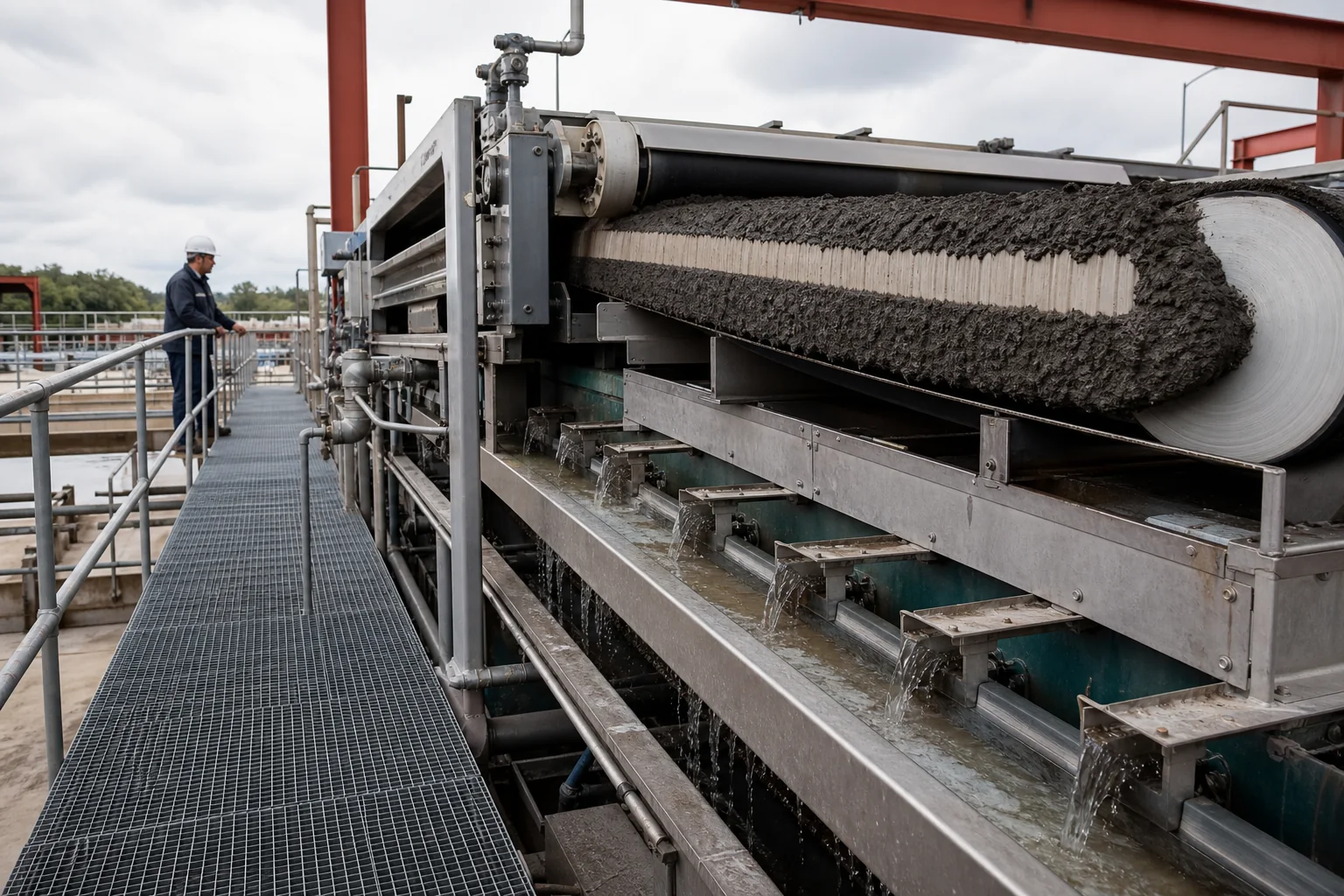
A cationic PAM selected for a centrifuge is not automatically a qualified filter-press product. Pressure filtration has its own drainage, cake and cloth constraints. Match the candidate to the actual residual and the installed press cycle before purchasing against an attractive laboratory floc.
Describe the press and conditioning sequence
Identify whether the plant uses a plate, recessed-chamber, membrane or another press arrangement, with relevant equipment information supplied by its operator. State upstream chemicals, feed solids and where polymer enters. Keep safe operating limits with the equipment team. Do not assume that more polymer compensates for an unsuitable cycle or cloth condition. Explain the current problem so the trial distinguishes conditioning from a mechanical or maintenance limitation.
Use a representative filtration screen
Compare candidates with the incumbent under controlled preparation and active dose. Bench filtration can narrow the range if it represents the duty, but it cannot prove the full installed press cycle. Record filtrate quality and the progression of water release, not just initial drainage. Preserve observations of cake structure and potential handling difficulties. The sample evaluation checklist keeps product identity and experimental conditions traceable.
Assess cycle completion and cake release
Evaluate the practical fill and filtration sequence, cloth condition, cake handling and repeatability during a controlled machine trial. A candidate that improves one early observation may create a difficult final release or higher cleaning burden. Include solids capture where relevant, rather than reading a single cake-solids measurement as the entire result. Do not invent a universal cake target or filtration time; define acceptance against the actual plant duty and operating constraints.
Include chemical and cycle costs in the order
Normalize polymer consumption and compare the whole cycle, including meaningful operating and solids-handling costs. Keep other conditioning reagents visible when they differ between candidates. The cake and haulage comparison helps avoid a purchasing decision based only on powder price. Approve a specific product and tested method, then confirm packaging and repeat-lot documents for that identity.
Evidence needed before purchase
Record the actual observation or document reference against each item. If a condition was not tested, keep it visible as an approval limitation. Purchasing, operations and receiving should use the same candidate identifier so a favourable result is not transferred to a different product or unreviewed delivery.
| Decision | Evidence | Release condition |
|---|---|---|
| Press duty | Equipment type, feed and addition sequence | Trial represents the installed filtration process |
| Cycle result | Filtrate, cake release and cloth observations | Qualification includes full-cycle behaviour |
| Purchase balance | Polymer use and relevant operating costs | Lower unit price does not conceal a worse cycle |
Information to send with the quotation request
Send press type, representative sludge, solids range, upstream conditioning and polymer injection method. Include the existing cycle and the target improvement, such as filtrate quality, release or stable throughput. Request samples for this filtration duty rather than relying on approval from a different dewatering machine.
Include the required quantity, packaging method and destination with the technical evidence. Use the cationic PAM trial and RFQ route for a focused sample review, then confirm documents, packaging and supply scope for the approved product. Gongyi Xinqi Polymer Co., Ltd. can review the application and quotation requirements. Grade suitability, delivery availability and commercial terms need confirmation; no universal dose or guaranteed treatment outcome should be inferred from an application name.
Sample pathway
Send the feed condition and machine target.
A focused sample set starts with representative sludge, active dose, equipment and acceptance data.