
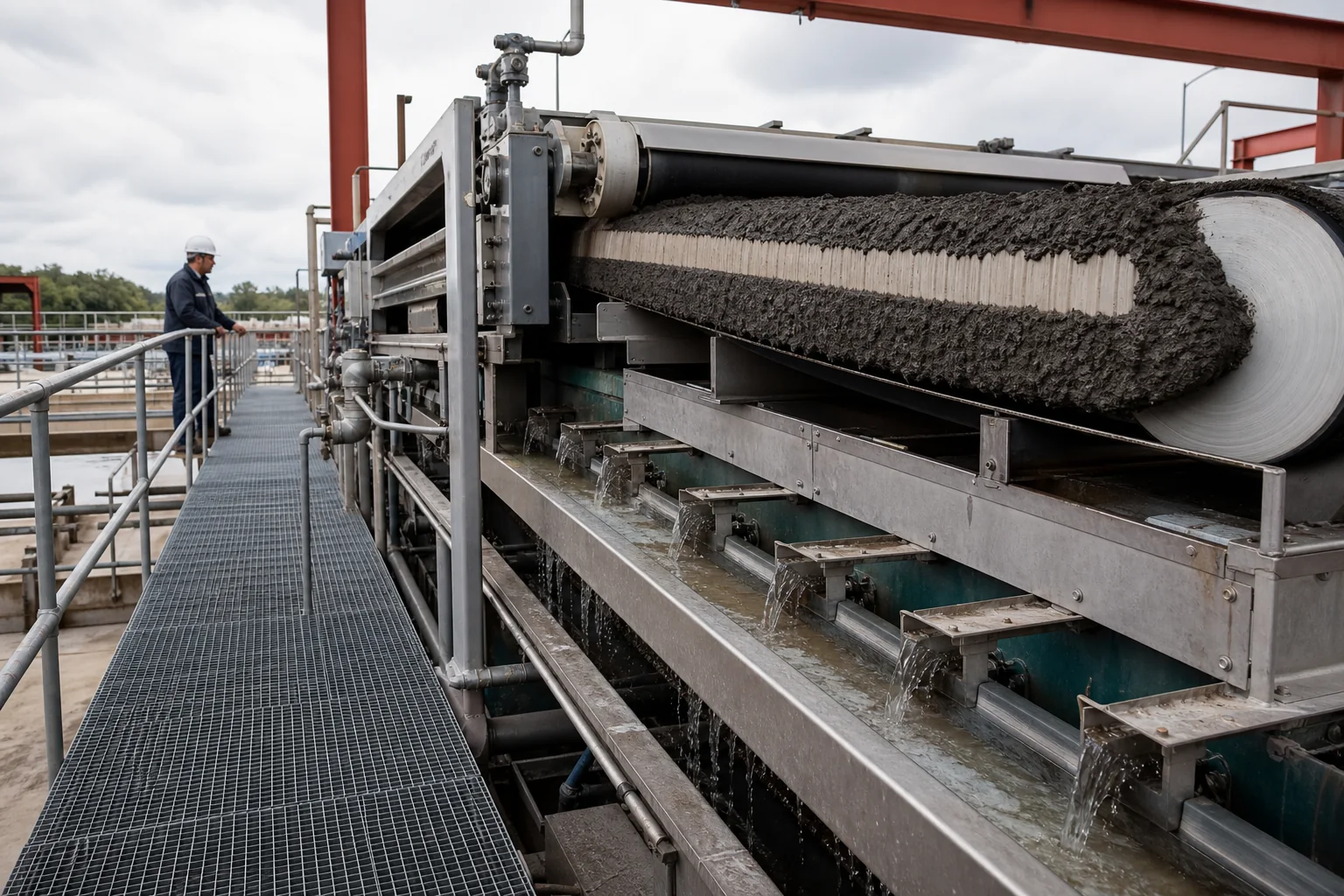
Belt press polymer selection begins in the gravity drainage zone. The conditioned sludge must release free water, remain on the belt, enter the wedge zone evenly and form a cake that survives compression and releases cleanly.
Watch the full belt path
Observe initial water release, lateral spread, drainage through the belt, edge loss, wash-water demand, tracking and cake release. A product that makes very large floc can still blind the belt or create uneven loading. Record filtrate appearance at more than one position.
Control feed and solution preparation
Changes in sludge solids directly change dry loading and active polymer demand. Confirm dilution water quality, stock concentration, maturation and secondary dilution. Poorly hydrated particles can lodge in the belt and imitate an equipment problem.
Balance cake and capture
Increase dose in defined steps and record cake solids, filtrate solids, throughput and belt condition. Stop when additional polymer no longer improves the combined objective or when sticky cake and poor release appear. Cost should be calculated per dry ton treated and per ton of cake transported.
Use a drainage test before the plant run
A repeatable screen or funnel drainage test can compare charge and molecular ranges before full-scale work. It does not replace the press because pressure, belt weave and shear differ. Use the belt-press test sequence to link bench observations with plant acceptance.