
Cationic charge density is a screening variable that changes adsorption and charge interaction with sludge. It is not a strength ranking. The most useful grade is the one that creates a broad, controllable performance window on the actual feed and dewatering machine.
Start with the reason cationic PAM is being tested
Biological and many organic sludges contain negatively charged surfaces and hydrated extracellular material. A cationic polymer can reduce repulsion and connect particles into drainable floc. The required charge depends on the solids, dissolved chemistry, digestion, coagulant residuals and polymer architecture. A higher cationic label does not guarantee drier cake.
Characterize the sludge before assigning samples
Record source, primary-to-secondary ratio, digestion, total solids, pH, conductivity, temperature and upstream ferric, alum or PAC. Include industrial constituents such as fat, fiber, surfactant or dye where relevant. Use fresh representative sludge and note collection time because biological material can change during storage.
Build an adjacent-grade matrix
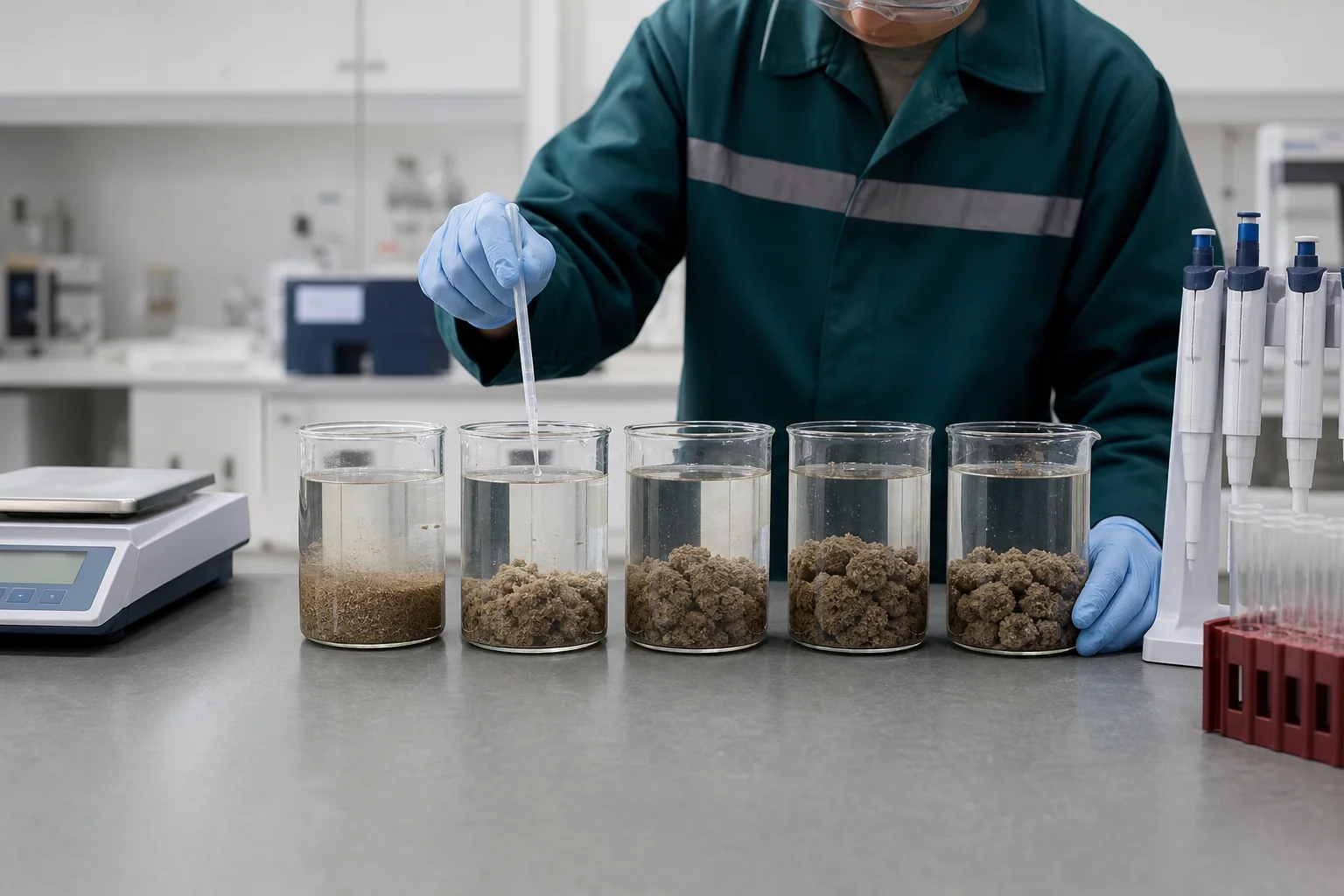
Choose low, medium and high charge candidates within a practical molecular range. Prepare solutions with the same water, concentration, mixing and maturation. Compare them first at equal active dose, then construct a dose curve around the promising range. Random pump changes cannot separate charge response from dose response.
Apply a repeatable mixing sequence
Use rapid initial distribution followed by gentler floc growth. Keep time and energy consistent for every beaker. Add a controlled shear step when the plant machine is a centrifuge or another high-shear device. Record floc formation speed, size, resilience, supernatant or filtrate and water release.
Test the overdose boundary deliberately
An overdose point teaches operators what excess polymer looks like. Symptoms may include sticky sludge, hazy water, poorer drainage or a response that worsens after an initial optimum. High-charge products can cross the useful window quickly on some feeds, so narrow dose steps are important.
Translate the beaker to the equipment
For a belt press, prioritize gravity drainage, capture, belt condition and cake release. For a centrifuge, balance centrate solids, cake, torque and throughput. For a screw press, observe filtrate, ring fouling and discharge. Select the equipment endpoint before ranking the grades.
Compare total operating cost
Calculate active polymer mass per dry ton. Include cake transport, return-liquor solids, throughput, cleaning and operational stability. A lower dose is useful only if the whole process remains acceptable. Retain the test record with the approved grade and lot reference.
The US EPA municipal sludge dewatering manual describes polymer conditioning as equipment- and sludge-dependent. Review it as background, then validate every product on the actual feed: Design Manual: Dewatering Municipal Wastewater Sludges.
Use simple observations before advanced tests
Plants do not need a complete surface-chemistry laboratory to run a disciplined screen. A consistent beaker sequence, timed drainage, measured filtrate volume, turbidity or suspended-solids check and repeatable shear step can reveal whether a grade has a useful response. More advanced charge-demand, CST or SRF tests may support the work, but they should be interpreted with the same representative sludge and a defined method.
Account for upstream coagulants
Ferric, alum, PAC, lime and pH adjustment can change the particle surface and the amount of cationic polymer required. Keep coagulant condition fixed during the initial comparison. If the plant intends to optimize both chemicals, first identify a stable baseline and then use a small matrix rather than changing both doses at random. Record chemical sequence because adding polymer before or after a coagulant can produce different floc.
Plan for feed variability
Repeat the shortlist on more than one operating condition when sludge changes materially. Digester operation, industrial contribution, rainfall, return streams and seasonal biology can move the useful window. A slightly lower peak result with consistent performance across the normal range may be easier and cheaper to operate than a narrow optimum. Set a practical dose band, not one exact number.
Create an approval record
The final record should identify sample and lot, solution method, charge family, active dose, feed properties, machine settings and measured endpoints. Photograph the same test stage for every candidate. Retain the rejected overdose point and the reasons for selection. This evidence helps technical staff diagnose future changes and prevents a purchasing decision from being reduced to a vague “high-charge” or “low-charge” description.
What to send with the sample request
Summarize the normal and difficult sludge conditions, current active dose, preparation system, separator and required outcome. Attach the comparison sheet rather than only a photograph of the best beaker. This allows the product team to refine molecular range within the useful charge family and prevents the next trial from restarting with unrelated grades.