
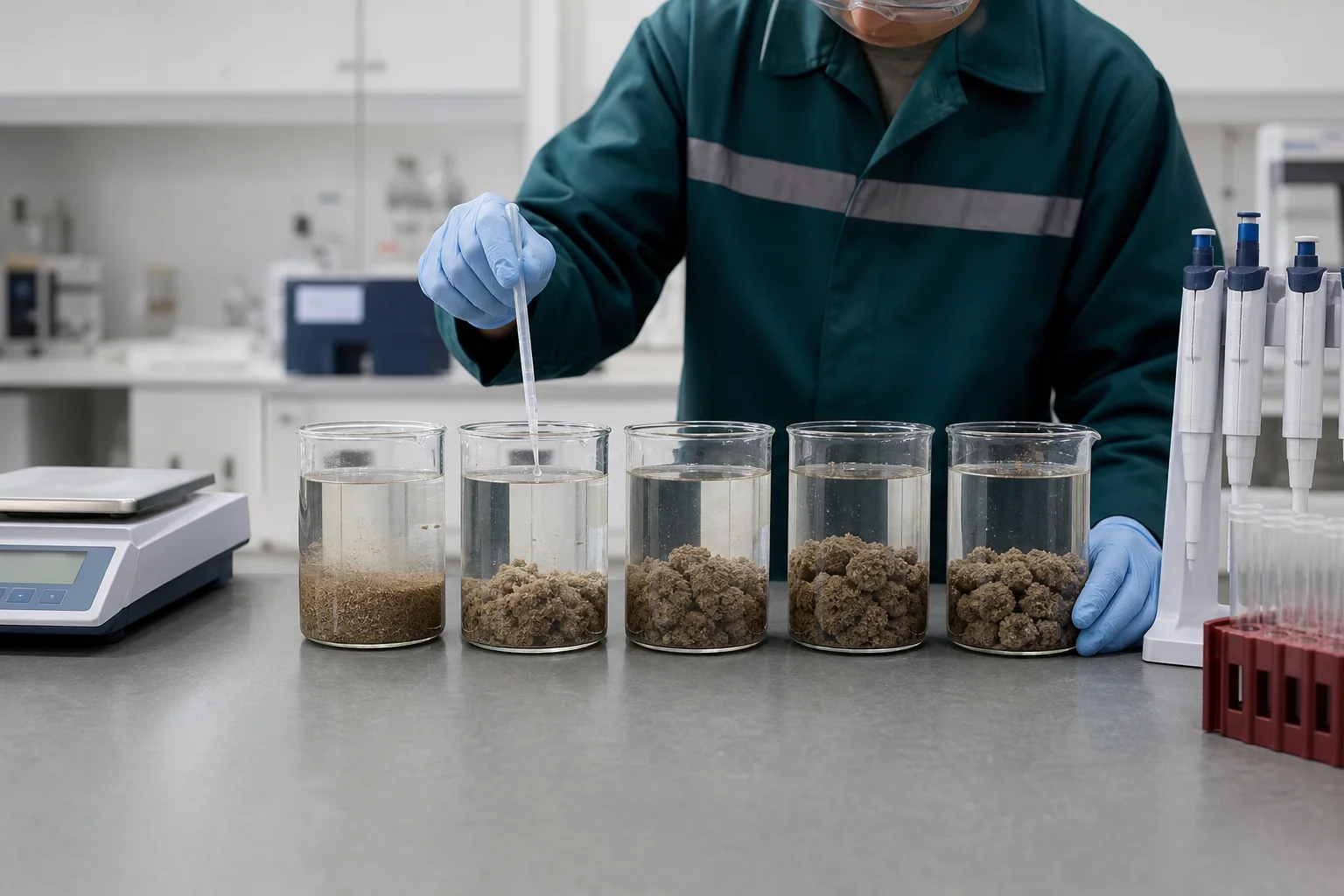
Waste activated sludge can be difficult to dewater, but its name does not specify the right cationic PAM. A useful purchase begins with representative feed and the actual machine target. Compare adjacent candidates while keeping preparation and dose calculations controlled, then retain evidence for the approved product.
Identify the WAS delivered to the machine
State whether the sludge is thickened, blended or treated before dewatering. Record feed solids and the normal range, not only a conveniently concentrated sample. Include relevant biological operating changes and upstream chemicals where known. A sample collected after prolonged storage may behave differently from the live feed. Explain the collection point and handling interval so the supplier can distinguish waste activated sludge from a mixed or digested material.
Use a charge screen without assigning a universal grade
Positive-charge polymers are commonly screened for biological sludge, but higher charge is not automatically better. Compare candidates on the same feed and a consistent active-dose basis. Hold molecular range and preparation information visible rather than reducing approval to a charge label. The charge-density selection guide explains how adjacent ranges help identify an operating window instead of a single attractive beaker result.
Make the separator result the acceptance test
Measure the endpoints relevant to the installed machine: solids capture, centrate or filtrate quality, cake condition and practical throughput. Drainage observations can narrow the sample set but do not reproduce every centrifuge or press condition. Include transfer and mixing where the feed is exposed to them. If a candidate improves one endpoint while materially worsening another, compare the full operating consequence before approving a supply order.
Link consumption to the qualified operating range
Calculate demand from actual dry-solids loading and the successful dose range. Avoid estimating monthly purchase volume from treated-water flow alone when the polymer is used for sludge conditioning. Include normal feed variability and preparation losses that are actually observed. Review the dry-ton dose calculation before comparing quotations, and identify which candidate and preparation procedure generated the consumption estimate.
Evidence needed before purchase
Record the actual observation or document reference against each item. If a condition was not tested, keep it visible as an approval limitation. Purchasing, operations and receiving should use the same candidate identifier so a favourable result is not transferred to a different product or unreviewed delivery.
| Decision | Evidence | Release condition |
|---|---|---|
| Feed identity | WAS source, thickening and solids range | Sample represents the actual dewatering feed |
| Machine result | Capture, liquid quality, cake and throughput | Candidate meets the agreed combination of endpoints |
| Demand | Dry-solids load and verified dose basis | Purchase volume follows the qualified duty |
Information to send with the quotation request
Send the WAS collection point, thickening method, feed-solids range, machine type, current polymer and measured dose. Identify the required capture or cake target and whether blending or biological operating changes occur during normal production. State the time between sampling and testing, because an aged sample should not be presented as a fresh-feed control.
Include the required quantity, packaging method and destination with the technical evidence. Use the cationic PAM trial and RFQ route for a focused sample review, then confirm documents, packaging and supply scope for the approved product. Gongyi Xinqi Polymer Co., Ltd. can review the application and quotation requirements. Grade suitability, delivery availability and commercial terms need confirmation; no universal dose or guaranteed treatment outcome should be inferred from an application name.
Sample pathway
Send the feed condition and machine target.
A focused sample set starts with representative sludge, active dose, equipment and acceptance data.