
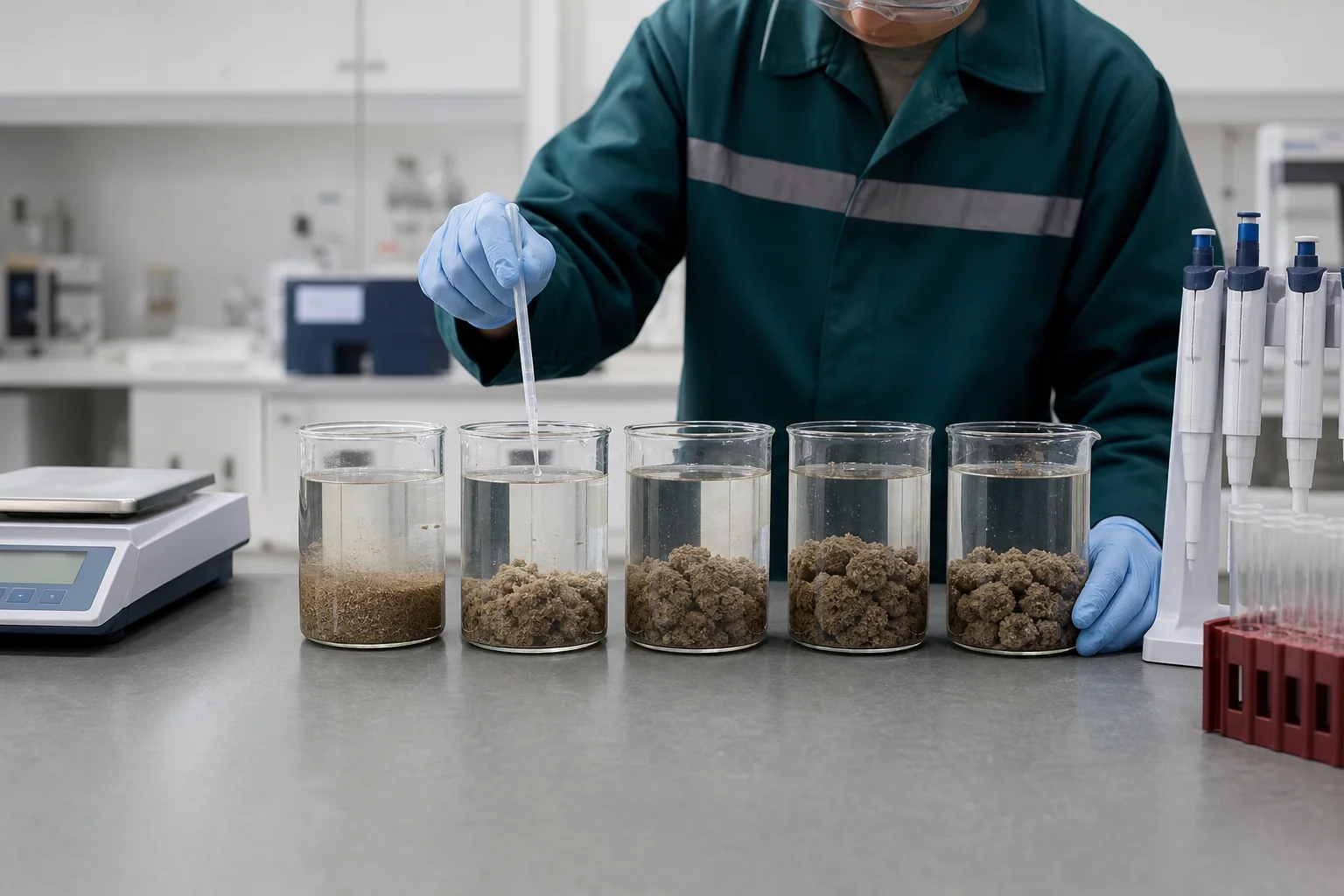
Low-charge cationic PAM may be a useful starting range when the feed has a lower negative-charge demand, contains a meaningful mineral fraction or responds poorly to stronger cationic products. It should be tested beside a medium-charge grade rather than selected from sludge name alone.
Where the range may fit
Potential duties include selected primary sludge, mineral-organic mixtures, some paper-process sludges and feeds conditioned with inorganic coagulant before polymer addition. Upstream ferric, alum or PAC can change surface charge and move the useful polymer range. Record those chemicals in every sample request.
What a successful trial should show
Look for a repeatable improvement in drainage or centrate clarity at a controlled active dose. Floc should remain coherent through the machine without leaving excessive fines. Cake release, belt cleanliness, torque, bowl solids and return-liquor load may be more important than the largest beaker floc.
Recognize a poor fit
Persistent pin floc, slow drainage and a steep response to small dose increases can indicate insufficient adsorption or an unsuitable molecular range. Before moving to a higher charge, confirm full dissolution, actual pump delivery, injection mixing and representative feed solids. Use the dry-solids dose calculation to compare trials fairly.
Order only after adjacent-grade comparison
Request the low-charge sample with at least one adjacent medium-charge product. Report sludge source, feed solids, equipment, current polymer and acceptance targets. Xinqi Polymer can then align product form, packaging and documents with the proven grade rather than a generic label.