
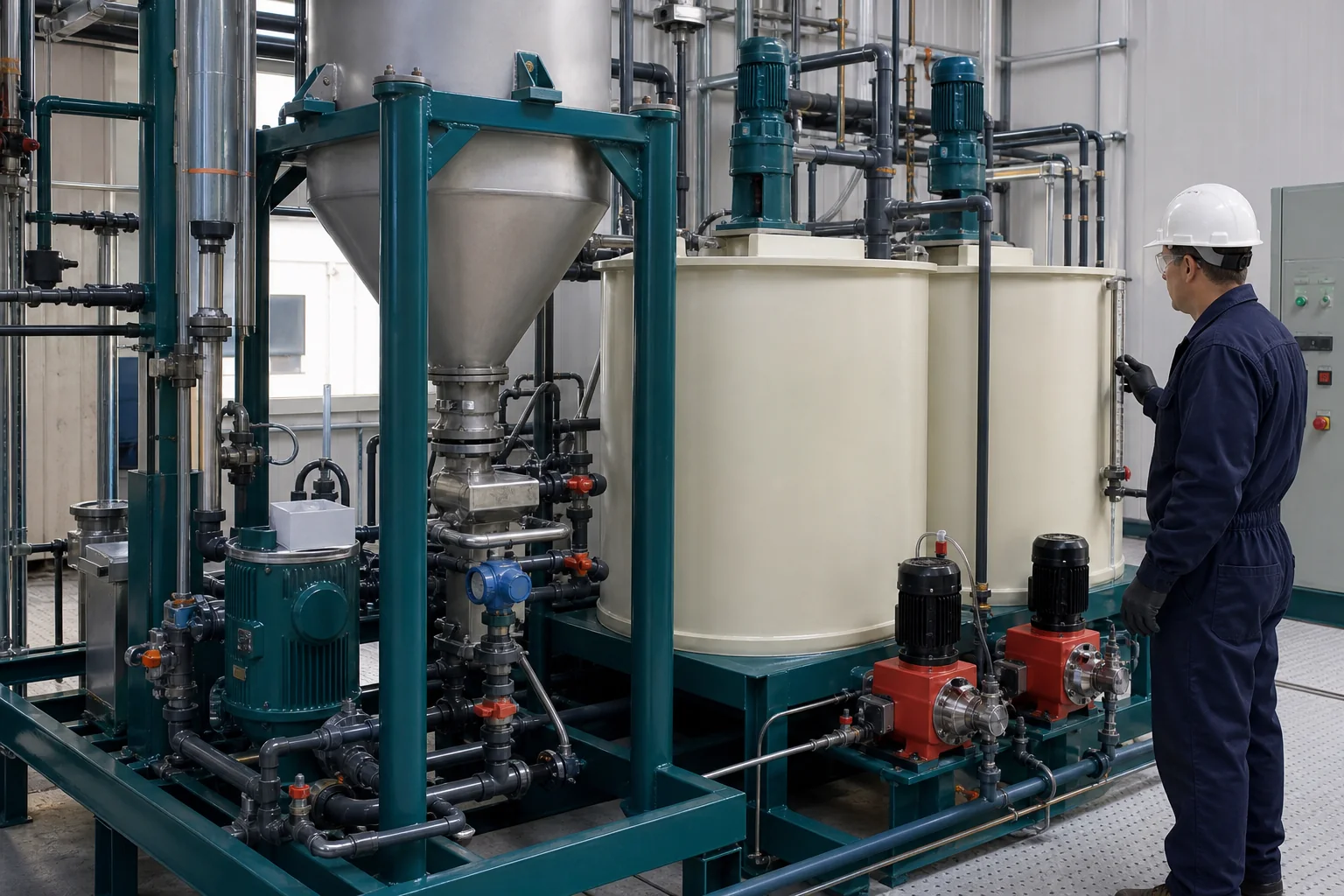
Powder and emulsion cationic PAM can both condition sludge effectively when the correct grade is prepared and applied properly. Product form changes handling, equipment and cost; it does not remove the need for application testing.
Compare on active polymer basis
Dry powder has high active content but requires powder feeding, wetting and maturation. Emulsion contains polymer in a carrier system and needs correct inversion and dilution. Compare active dose rather than equal as-supplied mass, and include auxiliary chemicals where required.
Consider preparation time and footprint
Powder systems generally need an induction and aging sequence. Emulsion can develop usable solution more quickly but still requires appropriate equipment and control. Existing plant footprint, automation, redundancy and maintenance capability may decide which form is practical.
Assess storage and handling
Dry product must be protected from moisture and requires dust controls consistent with the SDS. Emulsion has temperature, separation and shelf-life considerations defined by its documentation. Evaluate spill response, transfer, pump compatibility and cleaning for both forms.
Verify solution quality
Powder failures commonly involve fisheyes, insufficient aging or excessive shear. Emulsion failures can involve poor inversion, incorrect dilution or product condition. Inspect the prepared solution and confirm actual active delivery before ranking dewatering results.
Test the same application endpoints
Use representative sludge and identical equipment criteria: filtrate or centrate solids, cake, capture, throughput, cleaning and active dose. Product form should not be selected solely from solution appearance or speed of floc formation.
Calculate delivered treatment cost
Include product, freight, storage, preparation water, equipment, energy, maintenance, labor, cleaning, cake transport and return-liquor impact. A lower bag price or faster inversion may not produce the lower total cost.
Plan changeover carefully
Do not mix product forms or incompatible residues in common tanks without a validated cleaning procedure. Update calibration, active fraction and control logic. Train operators to recognize the new preparation and overdose boundaries.
Request a form-specific trial
Provide the present system, available footprint, feed data, equipment and quantity. Xinqi Polymer can review whether powder or emulsion sampling is appropriate. The sample trial checklist captures the required data.
Compare supply-chain resilience
Consider lead time, storage capacity, packaging, transport classification, cold or hot climate exposure and backup inventory. Product form may affect how much active polymer fits in storage and how easily emergency supply can be handled. Confirm the actual product documentation rather than assuming all emulsions or powders have identical requirements.
Review operator exposure and housekeeping
Powder handling requires controls for dust and slippery spills; emulsion handling requires controls for liquid transfer, spills and carrier components. The SDS and plant risk assessment govern protection and cleanup. Include housekeeping time and the consequences of a spill in the practical form comparison.
Check equipment compatibility
Review feeder turndown, induction capacity, tank volume, agitators, emulsion pumps, inversion system, elastomers, pipe size and control signals. A laboratory winner is not a deployable option if the plant cannot prepare it consistently. Estimate conversion changes before committing to production supply.
Run a parallel cost model
Build separate rows for as-supplied price, active content, freight, dilution or inversion, preparation energy, maintenance, labor, storage and disposal impact. Use measured plant dose and performance. Sensitivity-test the result for feed variation and throughput so a short trial at one condition does not create a misleading annual estimate.
Define the decision trigger
Some plants choose powder for high active content and established make-down capacity; others choose emulsion for rapid preparation or space constraints. State the plant-specific reason and the performance evidence. Keep a contingency for supply interruption and document how calibration and operating instructions change between forms.
Use a staged conversion trial
Confirm bench performance, then operate the proposed preparation system at realistic demand before a long plant run. Verify active fraction, calibration, solution quality, injection and response through start-up and steady state. Track inventory and consumption independently. A staged trial identifies handling or control problems before product form is written into a supply agreement.
Keep product-form claims specific
Avoid universal statements that one form always dissolves faster, costs less or produces stronger floc. Those outcomes depend on formulation, equipment, water, active content and application. State the measured plant condition and retain the supplier documentation used for the calculation. This keeps the decision valid when comparing later offers.