
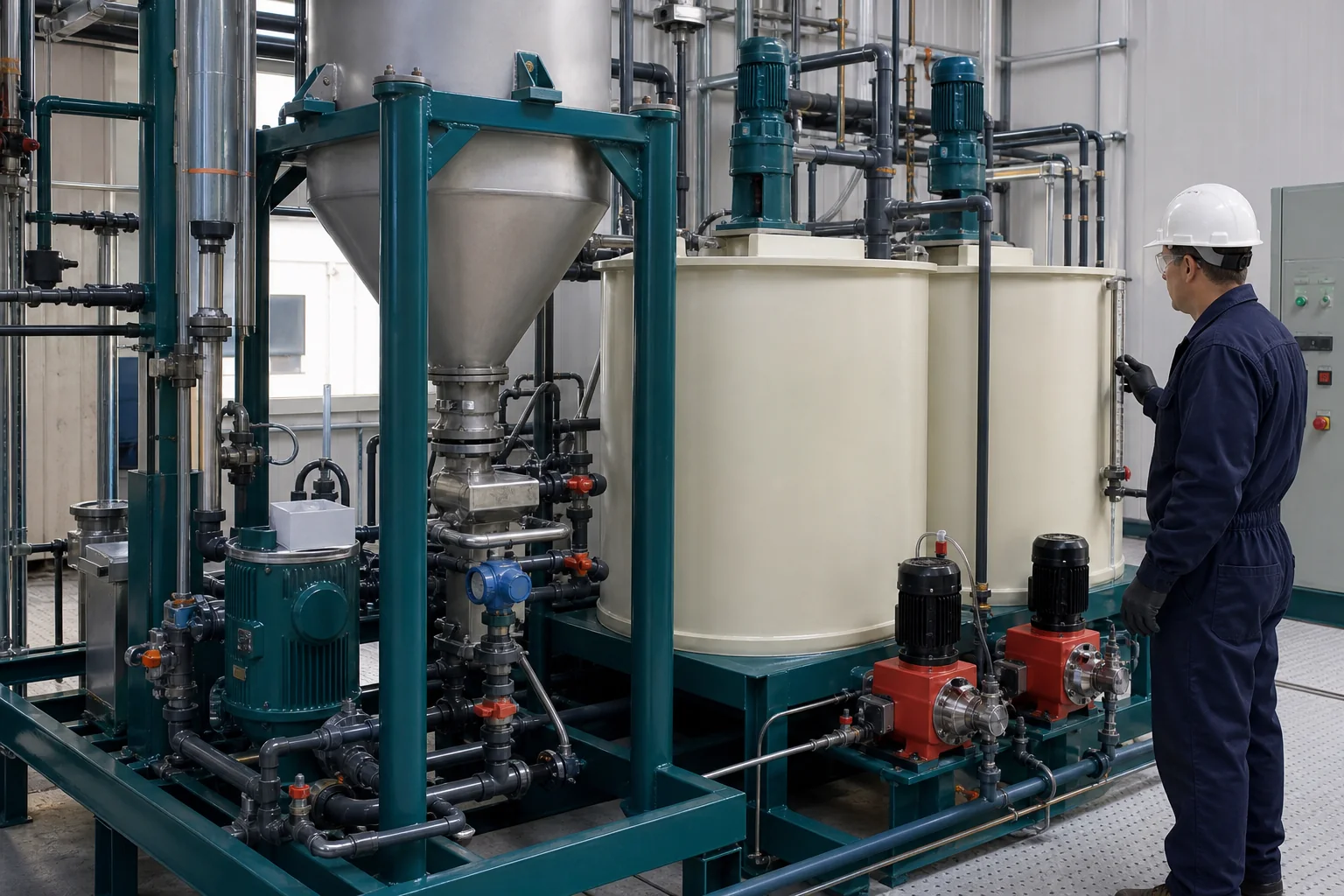
A dry cationic PAM that performs well after careful laboratory preparation can still be difficult to use in an existing feeder. Product purchasing should include powder transfer, measured mass addition and solution preparation. Neither free-flowing appearance nor a brochure dissolution claim proves installed-system compatibility.
Describe package transfer and feeder constraints
Provide feeder type, hopper, unloading method and the package sizes the plant can handle safely. Ask the equipment supplier which material properties and transfer limits matter. Do not assume every granular product delivers the same mass at an unchanged screw setting. If a candidate needs different handling or settings, record the requirement before comparing a bulk quotation. A package that saves freight but cannot be transferred safely is not an equivalent supply option.
Calibrate addition and check wetting
Measure powder addition safely using a representative method, with the water flow and intended concentration recorded. Compare wetting at normal and peak demand. Excessive addition can create agglomerates even for a suitable polymer. The preparation guide keeps wetting and aging separate. Do not interpret a nominal feeder percentage as proof of concentration or treatment dose when actual output has not been measured.
Verify usable solution capacity
Record preparation concentration, water source, temperature and aging time. Assess whether the system can supply usable solution at the required demand without shortening the qualified cycle. Check transfer and pump delivery with the candidate rather than relying on water-rated equipment output. If dilution is needed for practical handling, include the increased solution volume and tank demand. A product change cannot be qualified by chemistry alone when capacity becomes the limiting factor.
Approve preparation and treatment together
Keep feeder output, preparation quality and dewatering results in the same approval record. Observe humidity exposure and cleaning procedures at the point of use, distinguishing those conditions from closed-package storage. Follow SDS and equipment procedures rather than improvising around a running feeder. Use incoming-lot checks to maintain identity and condition after the candidate is purchased.
Evidence needed before purchase
Record the actual observation or document reference against each item. If a condition was not tested, keep it visible as an approval limitation. Purchasing, operations and receiving should use the same candidate identifier so a favourable result is not transferred to a different product or unreviewed delivery.
| Decision | Evidence | Release condition |
|---|---|---|
| Transfer | Package method and equipment constraints | Product can be handled safely |
| Preparation | Measured powder rate, water and aging | Usable solution matches the approved method |
| Useful duty | Delivery capacity and dewatering result | Feeder convenience does not replace treatment acceptance |
Information to send with the quotation request
Send feeder and package-transfer details, stock concentration, measured powder rate, water source and available aging time. Include peak dosing demand, existing pump arrangement and the current product reference. Explain whether the proposed purchase requires a setting change or an actual equipment conversion.
Include the required quantity, packaging method and destination with the technical evidence. Use the cationic PAM trial and RFQ route for a focused sample review, then confirm documents, packaging and supply scope for the approved product. Gongyi Xinqi Polymer Co., Ltd. can review the application and quotation requirements. Grade suitability, delivery availability and commercial terms need confirmation; no universal dose or guaranteed treatment outcome should be inferred from an application name.
Sample pathway
Send the feed condition and machine target.
A focused sample set starts with representative sludge, active dose, equipment and acceptance data.