
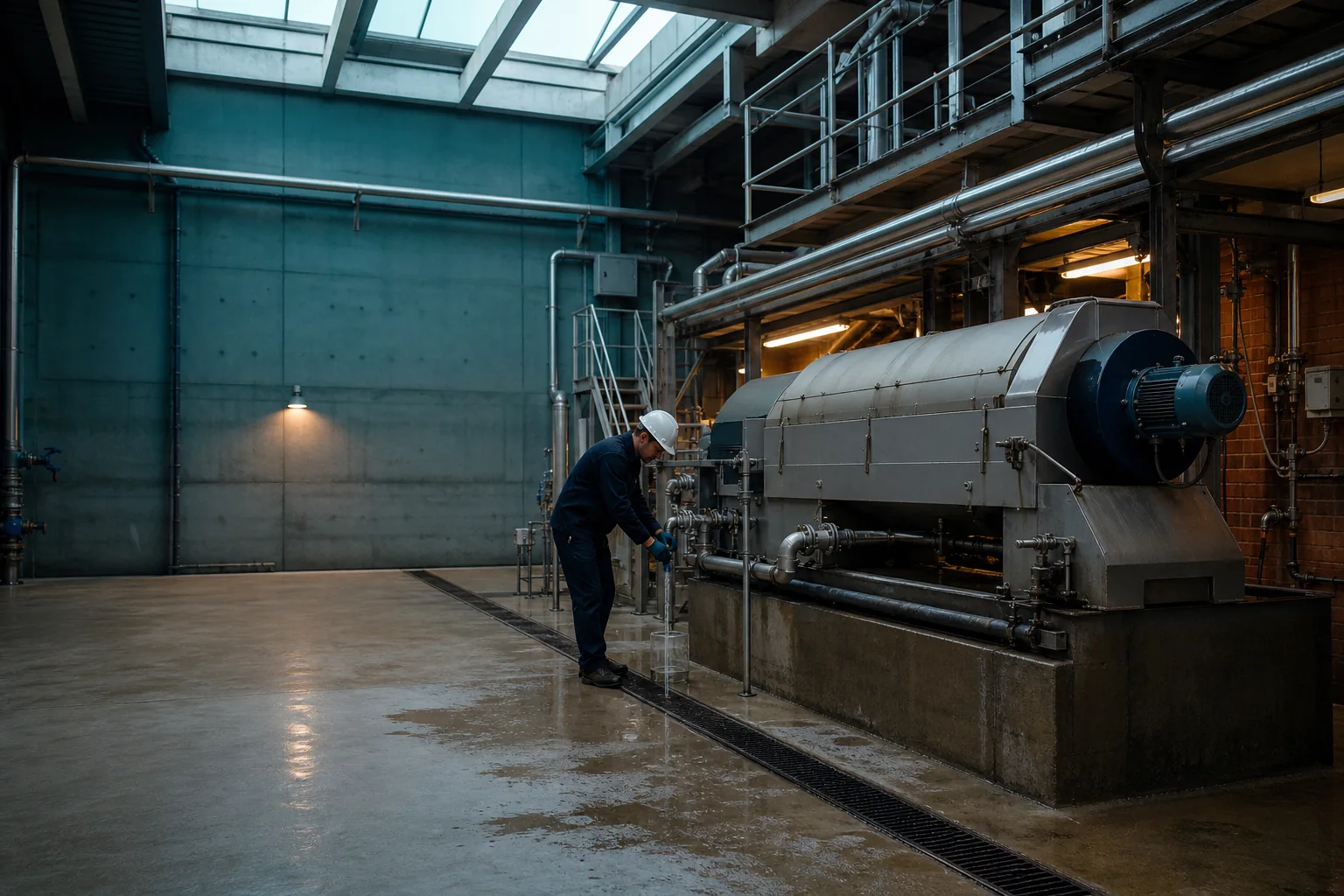
A decanter centrifuge needs polymer that conditions quickly and forms floc able to reach the separation zone without producing excessive fines. Grade selection must be evaluated together with feed solids, differential speed, pond depth, bowl speed, flow and torque.
Define a stable machine baseline
Record sludge flow and solids concentration, calculate dry-solids loading and confirm actual polymer pump delivery. Hold mechanical settings steady while comparing products. If settings change during the polymer test, the apparent grade ranking may reflect machine changes rather than chemistry.
Use centrate and cake together
Clear centrate with an unacceptable wet cake is not a complete success; neither is a dry cake obtained with high solids loss. Track centrate suspended solids or a consistent turbidity proxy, cake solids, capture, throughput, torque, polymer dose and return-liquor impact. Note foaming and the position of the solids discharge.
Diagnose the direction of change
When dose increases improve centrate only briefly and then create haze or sticky solids, investigate overdose. When floc forms in a bench test but breaks in the machine, check injection location, dilution, mixing energy and molecular range. When results move with feed solids, review dose control on dry-solids flow.
Scale from controlled steps
Use at least three active-dose points around the current condition and allow the centrifuge to reach steady state before collecting samples. The centrifuge diagnostic article gives a structured sequence for high centrate solids and unstable cake.